Introduction
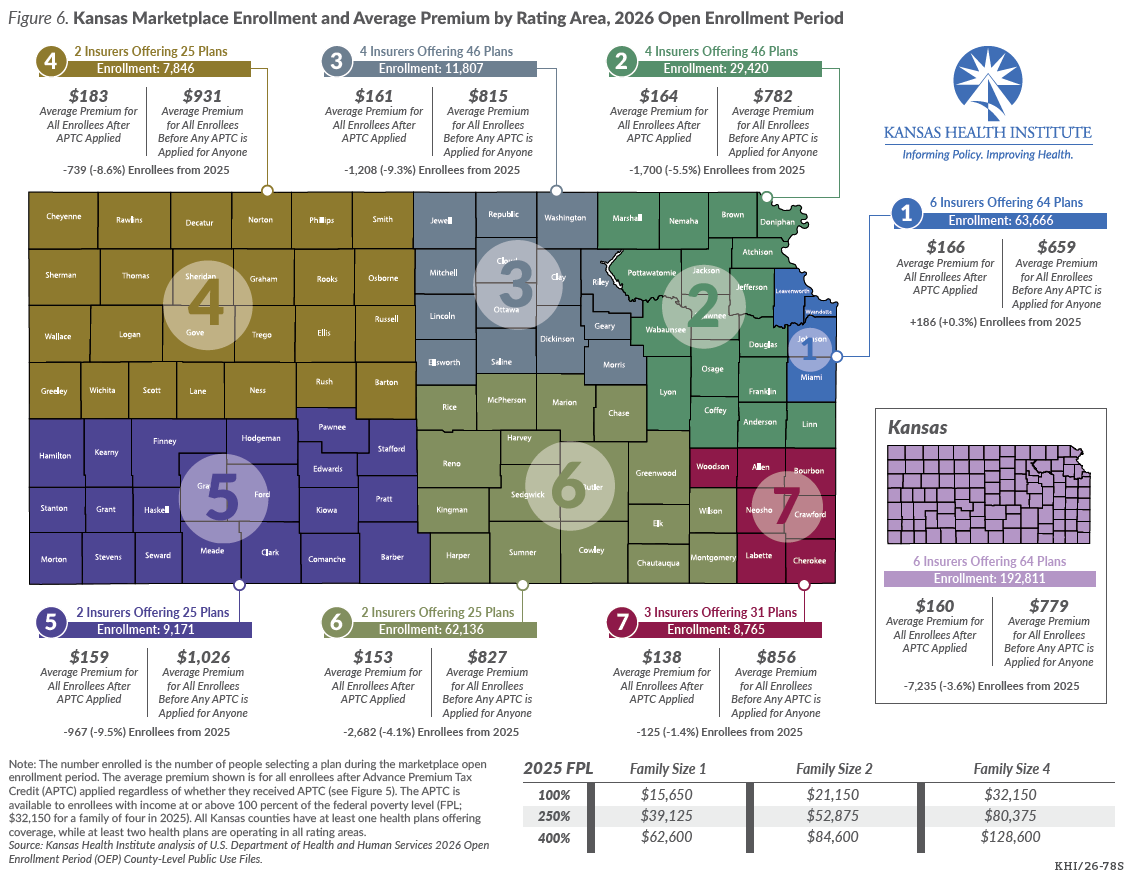
During the 2026 plan year open enrollment period (OEP) that ended Jan. 15, 2026, 192,811 Kansans selected or were automatically re-enrolled in a health insurance plan through the federally facilitated marketplace, a decrease of 7,235 (3.6 percent) enrollees compared to last year’s record high enrollment. Recently released CMS data indicate that 165,435 Kansans had effectuated coverage in January after paying their first month’s premium. Effectuated enrollment declined to 143,880 in February, a 25.4 percent decrease from open enrollment — more than double the approximately 10 percent decline during the same period in each of the previous four years.
This was the first OEP following the expiration on Dec. 31, 2025, of the enhanced Advance Premium Tax Credits (APTC) authorized under the American Rescue Plan Act of 2021 and extended through 2025 by the Inflation Reduction Act. This marks the first dip after four consecutive years of record high enrollment. In the United States, 23.1 million consumers enrolled during the 2026 OEP, which is a 4.9 percent decrease from 24.3 million the previous year. Without the enhanced tax credits, financial assistance available in the marketplace is at the original Affordable Care Act (ACA) levels.
This brief provides summary data from the 2026 OEP on enrollment in ACA marketplace health insurance, including enrollee characteristics, plan selection, financial assistance and premiums, as well as enrollment in stand-alone dental insurance in Kansas. The OEP lasted from Nov. 1, 2025, through Jan. 15, 2026. Coverage began Jan. 1, 2026, for those who enrolled on or before Dec. 15 and Feb. 1 for those who enrolled after Dec. 15.
Kansas Enrollment
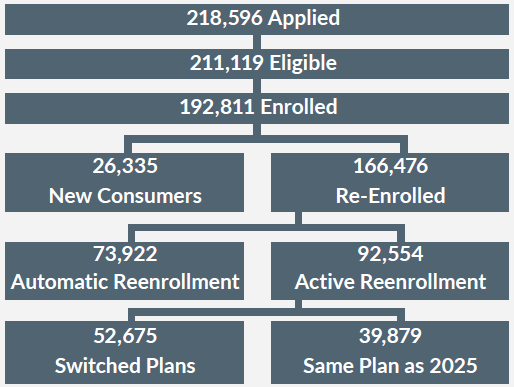
Data from the Centers for Medicare & Medicaid Services (CMS) show that 218,596 Kansans applied for a marketplace plan during the 2026 OEP and 211,119 were determined eligible to enroll. Among those who were eligible, 192,811 completed their enrollment by selecting a plan or by being automatically reenrolled (Figure 1). All areas in Kansas, except the Kansas City area, saw decreases in enrollment. Enrollment decreased the most between 2025 and 2026 in southwest Kansas (9.5 percent) and north central Kansas (9.3 percent). The Kansas City area saw a small increase of 0.3 percent.