In this infographic, Medicare enrollment includes beneficiaries enrolled in Original Medicare (also known as Traditional Medicare) or Medicare Advantage (also known as Part C). According to monthly enrollment data from the Centers for Medicare and Medicaid Services, about 196,000 Kansas Medicare beneficiaries were enrolled in Medicare Advantage plans as of December 2024. Medicare Advantage plans are Medicare-approved plans offered by private insurers as an alternative to Original Medicare. There are different types of Medicare Advantage plans, such as health maintenance organization (HMO), HMO point-of-service, preferred provider organization (local and regional), private fee-for-service, special needs and medical savings account plans.
This latest data reflect the end of Kansas’ Medicaid unwinding period, which concluded in May 2024. During the COVID-19 public health emergency, federal and state policies expanded access to health insurance coverage by allowing Medicaid and CHIP enrollees to maintain their coverage without eligibility redetermination. That continuous enrollment ended on March 31, 2023. As part of the unwinding process, states were required to restart the redetermination process. Kansas restarted eligibility reviews in April 2023 and completed the process by May 31, 2024. Some Kansans who lost coverage during the unwinding process were still enrolled in Medicaid or CHIP in the American Community Survey data used here, meaning the full effects of unwinding may not be fully captured.
Coverage in 2024 was also affected by enhanced eligibility for marketplace subsidies. Subsidies initially expanded under the American Rescue Plan Act of 2021 and extended through 2025 by the Inflation Reduction Act of 2022 remained available, including for some households with income above 400 percent of the federal poverty level (FPL) that previously had been ineligible for subsidies.
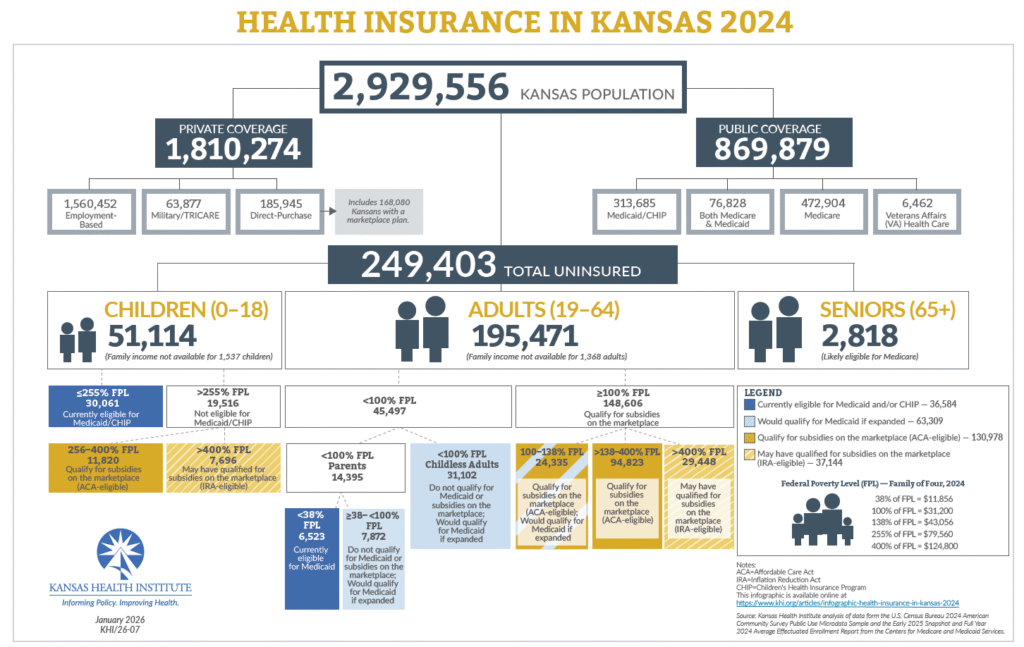
In 2024, about two-thirds of uninsured Kansans —168,000 or 67.4 percent — had household income that may have qualified them for marketplace subsidies. Of those, 131,000 (77.9 percent) Kansans may have qualified for subsidies under the original terms of the ACA and 37,000 (22.1 percent) may have qualified under the IRA.
As of January 2026, Kansas is one of 10 states that have not expanded Medicaid eligibility to adults with household income up to 138 percent FPL, as allowed under the ACA. In 2024, Medicaid expansion would have covered individuals with annual household income up to $20,783 and adults in a four-person family with annual household income up to $43,056. If the state had expanded its program in 2024, 63,000 uninsured Kansas adults would have become newly eligible for Medicaid coverage.
An additional 36,000 uninsured Kansas adults and children were likely already eligible for Medicaid or CHIP in 2024 but were not enrolled.