


Invisibility Is No Longer Harmless: Why Public Health Must Make Its Value Seen

Most of us who work in public health have probably heard the saying that when public health is working it is invisible. The idea is that prevention is supposed to happen quietly in the background. Public health doesn’t get shows like ER or The Pitt with Noah Wyle (in both cases) doing chest compressions or using a defibrillator to save people’s lives. However, the idea that public health should be invisible is no longer harmless, it’s dangerous.
For generations, invisibility was framed as a quiet badge of success. If outbreaks were prevented, water was safe and communities stayed healthy; the absence of crisis was proof the system worked. Public health didn’t need recognition, according to that sentiment, because the outcomes spoke for themselves. But the conditions surrounding public health have changed. Across the country, leaders are confronting workforce shortages that hinder hiring, unstable funding streams, political pressures that challenge legitimacy and systems strained by years of accumulating stress. These are not abstract trends. They are daily operational realities that point toward the need for transformation. In this context, invisibility is no longer humility. It is vulnerability.
From Running Programs Well to Creating Indispensable Value
Public health has long emphasized effectiveness and efficiency — delivering programs well, following evidence, meeting performance standards and improving outcomes. These remain essential. But they are no longer sufficient. A deeper shift is required to communicate and capture the value of public health.
The turning point is moving from running programs effectively to creating outcomes and value that stakeholders recognize, depend on and are willing to invest in. Trust matters but trust alone does not stabilize systems. Recognition of indispensable value does.
This distinction is subtle but profound. A program can be effective yet still disappear. A system can produce improved community health yet continues to lose funding, staff and influence. What determines survival is not impact alone, but whether that impact is seen, understood and reinforced by the people and institutions that authorize public health to exist.
How Public Health Value Actually Sustains Systems
To understand what should change, it helps to see public health value not as a single outcome, but as a cycle.
Public health organizations begin by delivering foundational services that protect communities and promote health. But services alone do not secure the future. Their meaning has to be communicated in ways that connect to what different stakeholders care about. Only then can value be perceived, shaping trust, legitimacy and willingness to invest. Value must first be recognized before it can be translated into funding, partnerships, policy support and public commitment that sustain the work. This ongoing cycle, from service delivery to communication, to perceived value, to captured and reinvested support, is what allows public health impact to endure rather than erode (Figure 1).
For example, consider communicable disease control—a function supported by nearly all local health departments. These programs prevent isolated cases from becoming outbreaks and outbreaks from becoming epidemics. They save lives, keep people out of the hospital and reduce missed work and school. They are essential to a healthy community. Yet many residents may not realize their health department provides this protection, or how directly it benefits them. Sustaining this infrastructure requires more than delivering high-quality services. Public health leaders should also make a clear case for investment and communicate that value to the stakeholders who shape public health funding and capacity. The difference can determine whether a program buckles under a small surge in cases or remains resilient during an epidemic.
Figure 1. Sustainable Value Creation in Public Health
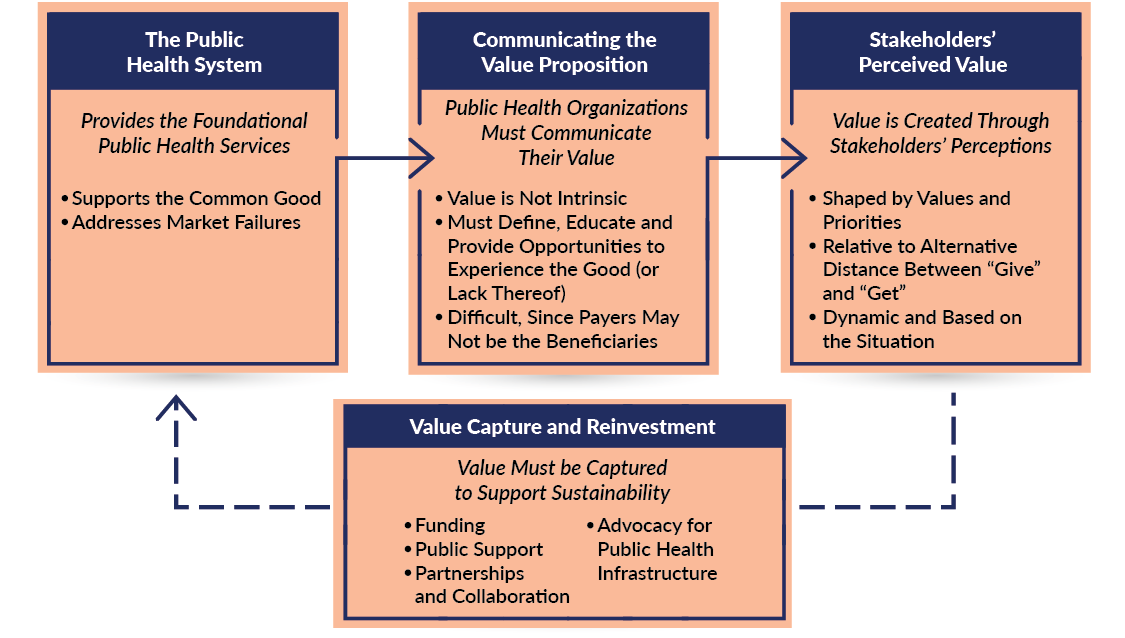
Source. Kovach, KA. Towards a Conceptional Framework for Creating and Sustaining Public Health Value. Journal of Public Health Management & Practice; Nov. 24, 2025.
The Leadership Shift Now Required
If this moment demands anything, it is a redefinition of public health leadership. The next generation of public health leaders must become brand ambassadors and influencers as much as nurses, epidemiologists, environmental health specialists or health educators.
Creating value still means improving health, preventing harm and advancing equity. But stewardship requires something more deliberate: ensuring that the value produced is recognized, supported and reinvested so the system itself can persist and continue to advance population health and health equity. This is not about abandoning core public health principles. It is about aligning them with what people care about.
Leaders should connect outcomes to what communities, policymakers, partners and funders view as meaningful. In doing so, they demonstrate how prevention strengthens economies, how preparedness stabilizes communities, how equity ensures communities are seen and heard, and how public health capacity protects every other sector. This not only makes what public health does visible, but answers why society cannot function without it.
This work takes time. Capturing value rarely happens immediately. But the benefits of thinking in terms of value begin right away. It changes how priorities are set, how resources are allocated, how partnerships are formed and how success is defined. It helps leaders ask different questions:
- Which outcomes truly matter to the people who sustain this system?
- Where is our value strongest but least visible?
- What support can we secure today to protect tomorrow?
These are strategic questions, and they are becoming central to system survival..
Bringing Public Health out of the Shadows
Public health needs to communicate its value more clearly and more powerfully. For too long, the field has relied on the assumption that impact would naturally translate into support. Experience now tells us otherwise. Value that is not seen cannot be sustained. Systems built on invisible success slowly weaken, even while doing important work.
Across the country, public health leaders are rethinking strategy, strengthening partnerships, modernizing data systems and redefining their role in community well-being. Within these efforts is an opportunity to move beyond invisibility, to build public health systems with value that is understood, supported and sustained.
The future of public health will belong to leaders who make this value visible.
Author’s note: This essay previews concepts explored more fully in KHI’s toolkit, Creating and Communicating a Winning Value Proposition for Public Health [insert URL], and in the Journal of Public Health Management and Practice article, Towards a Conceptual Framework for Creating and Sustaining Public Health Value. Together, these resources are designed to support public health leaders in translating impact into visible, enduring value for the communities and systems they serve.
About Kansas Health Institute
The Kansas Health Institute supports effective policymaking through nonpartisan research, education and engagement. KHI believes evidence-based information, objective analysis and civil dialogue enable policy leaders to be champions for a healthier Kansas. Established in 1995 with a multiyear grant from the Kansas Health Foundation, KHI is a nonprofit, nonpartisan educational organization based in Topeka.