
Information Hub: Digital Divide in Kansas

3 Min Read

Feb 24, 2026

By

Kaci Cink, M.P.H., Wen-Chieh Lin, Ph.D.
Happy mother assisting her child with school homework in living room.

In an increasingly digital world, internet access is essential for education, employment and health care. Growing evidence highlights the strong connection between broadband access and health outcomes, particularly in rural areas, where limited infrastructure and resources often make connectivity a greater challenge.

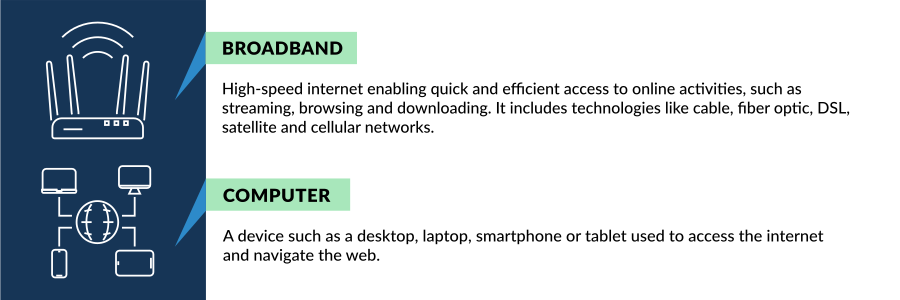
The Kansas Health Institute has developed this Digital Divide dashboard to provide a detailed overview of broadband and computer access across Kansas. Using 2019-2023 U.S. Census Bureau American Community Survey (ACS) data, the dashboard allows users to explore county-level data on computer and broadband access, as well as demographic breakdowns of populations without computer access by age, race, ethnicity, employment, education and income. This tool highlights disparities in ownership and availability, helping communities target efforts to close the digital divide.
Key Points

  • One in 10 (10.7 percent) Kansas households do not have broadband.
    • One-third (28.6 percent) of individuals with a household income less than $20,000 do not have broadband.
  • One in 20 (5.0 percent) Kansas households do not have a computer.
    • One in 10 (10.0 percent) Kansans age 65 and older do not have a computer to access the web.
  • Those with less than a high school diploma (9.9 percent) are nearly seven times as likely to lack a computer as those with a bachelor’s degree or higher (1.3 percent).
Table listing health insurance and stand-alone dental plans available in Kansas for 2025, categorized by company, type, county availability, and plan level (e.g., catastrophic, bronze, silver). Includes a total of 81 health plans and 16 dental plans, with variations in availability across counties.

Policy Updates

The Affordable Connectivity Program (ACP), which replaced the Emergency Broadband Benefit on Dec. 31, 2021, ended on June 1, 2024, due to a lack of additional funding. During its two-and-a-half-year run, the ACP enrolled over 23 million households nationwide, significantly reducing the digital divide.

Kansas has continued advancing broadband infrastructure and digital access. In December 2025, the National Telecommunications and Information Administration (NTIA) approved Kansas’ 166.6 million BEAD final proposal, positioning the state to expand high-speed internet across the state. Deployment is expected to begin in late 2026.

Additionally, the Freestate Middle Mile Network advanced in 2025 with a nearly $43 million federal grant from NTIA. The project focuses on bringing faster, more reliable internet to rural communities, improving public safety, transportation and essential local services, and creating new opportunities for internet providers to lease fiber networks.

Using the Interactive Map

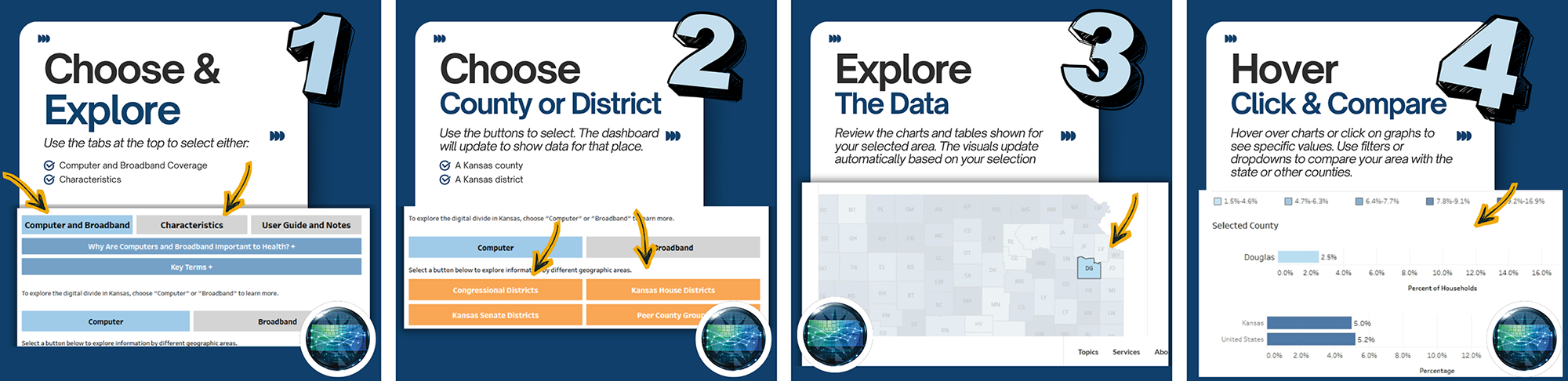
Illustration that shows how to use the information hub.

Interactive Map

Source: Kansas Health Institute analysis of data from the U.S. Census Bureau 2019–2023 American Community Survey 5-Year Estimates.

About Kansas Health Institute

The Kansas Health Institute supports effective policymaking through nonpartisan research, education and engagement. KHI believes evidence-based information, objective analysis and civil dialogue enable policy leaders to be champions for a healthier Kansas. Established in 1995 with a multiyear grant from the Kansas Health Foundation, KHI is a nonprofit, nonpartisan educational organization based in Topeka.

Learn More About KHI