


Are Local Health Departments the Linchpin for Rebuilding Trust in Public Health?

An Epidemic of Mistrust
The growing mistrust in public health might be the most important epidemic facing the field today. Trust in public health dropped during the COVID-19 pandemic, but it had already been eroding for decades. This erosion is part of a much broader decline in Americans’ confidence in institutions of all kinds. Public opinion data show that in 1958, nearly three-quarters of Americans trusted the federal government to do what is right most of the time. By 1980, that figure had fallen to 25 percent. Since then, trust has remined low, with only about one in five U.S. adults holding that confidence now.1
This issue is not unique to public health. The same downward trend shows up in other institutions, such as banking, education, organized religion and the media. But public health is being carried along in that current. Distrust of public health is deeply entangled with distrust of government and distrust of scientists. When Americans distrust public health institutions, they are often expressing something broader: a skepticism of authority and expert credibility, as well as a feeling that these institutions are not solving the problems they find most important.1
The COVID-19 pandemic accelerated and deepened these trends. A national survey showed that confidence in the Centers for Disease Control and Prevention (CDC) dropped from 82 percent to 56 percent between February 2020 and June 2022 — a decline of 26 percentage points.2 Confidence in the National Institutes of Health (NIH) fell by 25 percentage points over the same period, while trust in professional medical organizations fell by 26 points. Confidence in state and local health departments declined by 16 and 13 points, respectively. Even physicians were not spared, with public trust in them declining by 11 points. The causes cited are familiar: rapidly changing and sometimes conflicting recommendations, perceived political influence and broader concerns about transparency.3
These findings are not unique to this survey and are reflected in other polls, such as KFF’s Poll on Health Information and Trust, which found Americans’ trust in the CDC to provide reliable information about COVID-19 vaccines, other vaccines and the coronavirus declined from 83 percent in March 2020 to 47 percent in January 2026.4 This information confirms what we already know, that public health leaders need to make rebuilding trust with their communities and the American people a strategic priority.5
Local Health Departments as a Bright Spot
Confidence in all public health institutions declined by the peak of the pandemic but had begun to rebound by 2024. Still, trust in almost all public health institutions remained lower than in early 2020.2 The exception was local health departments, which saw a significant increase in high confidence from 67 percent in February 2020 to 73 percent by October 2024. By that point, local health departments were the public health entity Americans trusted most, reaching levels of confidence equal to those people had in their own doctor (Figure 1).2
Figure 1: Change in Confidence in Public Health Entities Among U.S. Adults: 2020 to 2024
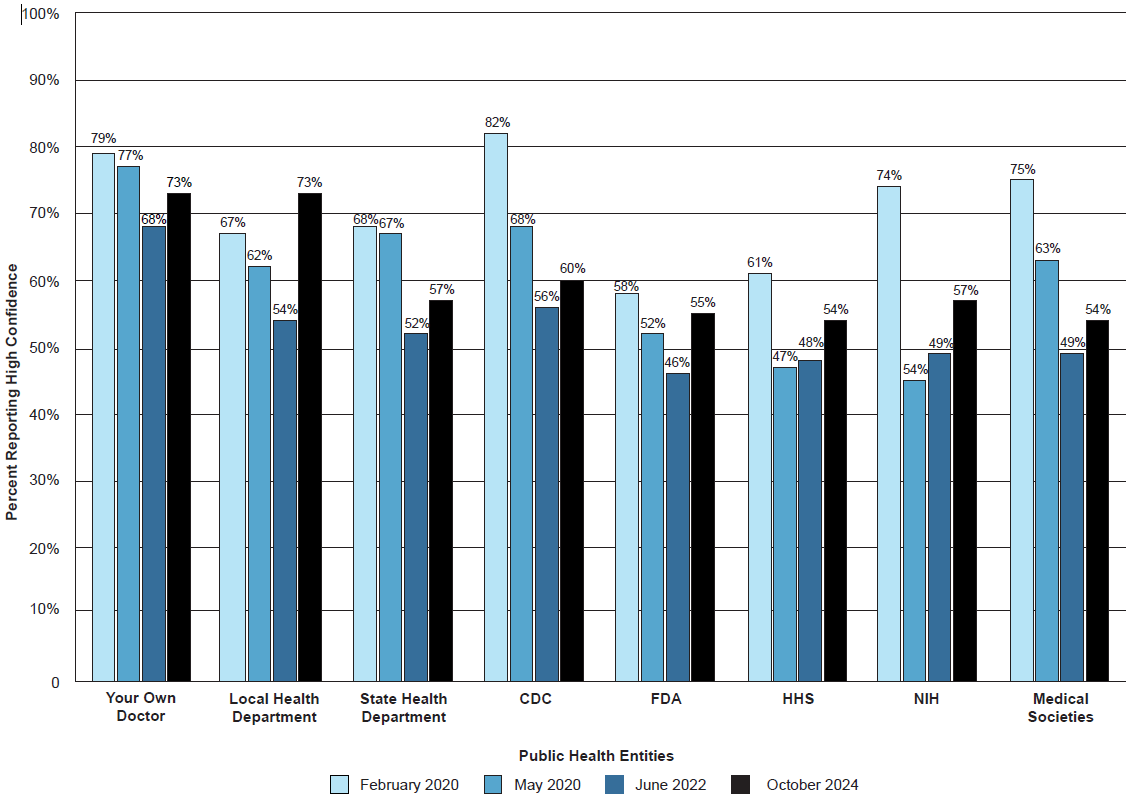
Note. Values represent the weighted percentage of U.S. adults reporting “high confidence” (rating of 4 or 5 on a 5-point scale). Surveys were conducted online using census-matched samples weighted by age, gender and race to the 2022 American Community Survey. Survey dates and sample sizes: February 4-7, 2020 (n=718); May 6-7, 2020 (n=672); June 8-13, 2022 (n=856); and October 20-27, 2024 (n=828).
Source: Melchinger H, Omer SB, Malik AA. Change in confidence in public health entities among U.S. adults between 2020-2024. PLOS Glob Public Health. 2025;5(6):e0004747. doi:10.1371/journal.pgph.0004747
These patterns are reflected in other data as well. In Missouri, local health departments rank as the second most trusted institution (60 percent), behind only fire departments (88 percent) and slightly ahead of police departments (59 percent).6 In North Carolina, trust in local health departments grew substantially following Hurricane Helene, rising from 43 percent to 68 percent among residents in affected counties.7 Nationally, KFF polling shows that local health departments are trusted to provide reliable vaccine information by more people (62 percent) than the CDC (47 percent), the Food and Drug Administration (57 percent) or state government officials (45 percent). 4
Why have local health departments been more successful at rebuilding trust than state or federal agencies? The answer may lie in differences in their foundations. A 2022 national survey by SteelFisher and colleagues found that the CDC was trusted more for its adherence to scientific principles and access to experts. In contrast, local health departments were trusted more for working hard under difficult circumstances, demonstrating genuine care for people and providing direct services to communities.3
This relationship-based foundation matters. Data from Missouri show that trust is 26 percentage points higher among people who use local health department services than those that do not.6 Data from North Carolina show that trust grew by 25 percentage points as local health departments responded to Hurricane Helene.7 Qualitative data also reinforce these findings. Participants in focus groups held by Schuh and colleagues said they trusted local health departments more than national organizations because they are embedded in the community, have a stake in its success, and understand local context better than national organizations, which participants viewed as influenced by politics. They also valued seeing frontline workers, as opposed to “officials, policymakers or the CDC.”8
These findings suggest that local health departments have been recognized for the human and relationship-centered dimensions of public health: compassion, hard work and direct care. These are assets that state and federal agencies cannot easily replicate.
The Role Local Health Departments Could Play in Rebuilding Trust
The data suggest that local health departments hold a distinctive trust advantage grounded in relationship-based credibility rather than scientific prestige. But holding an advantage is not the same as using it. Translating that goodwill into something durable will require strategic action and coordination across the nation at all levels of the public health enterprise. Below are three strategic moves that may help translate that advantage into tangible action.
Strategic Move 1: Demonstrate Competence by Solving Problems That People Care About
One dimension of trust is based on competence — can public health solve the problems people care about.9 This is reflected in the data. Blendon and Benson showed that Americans feel that public health and health care institutions aren’t doing enough to solve the problems they care about.1 To accomplish this, local health departments will need to know their community’s pulse and be able to connect their desires to the health department’s work in a meaningful way.10 Making community health assessment and community health improvement planning a core function of the health department’s work, as opposed to something they do every couple of years, will be essential. Engaging communities, not just organizations, as co-creators and decision makers will be required.11 The vision of public health accreditation was to develop a national network of high performing health departments.12 This goal is still essential and will be necessary to rebuild the trust needed for effective public health action. However, we must remember that there are other paths and indicators of high performance, while also recognizing that accreditation should be viewed as a floor, not a ceiling, for public health performance.
Strategic Move 2: Foster Integrity Through Ethical Stewardship and Public Value
The second dimension of trust, and arguably the more important one, is whether people believe institutions are acting with integrity.9 Integrity in public health is the community’s belief that an institution will manage power and resources fairly. Local health departments can exercise these dimensions through ethical decision-making and efficient stewardship of public dollars. Ethical decision-making requires considering alternative viewpoints and unintended consequences, as well as providing alternatives that provide different options for different levels of risk.13 Public health interventions should aim for the minimum effective dose — the smallest intervention needed to achieve the desired outcome.
Efficient stewardship requires showing communities the return on their investment. The majority of Americans believe their taxes are too high.14 While acknowledging that local health departments are already asked to do more with less, they can better demonstrate their value by communicating outcomes, showing how their work benefits various stakeholder groups — including some who may not recognize they are benefiting — and improving efficiency, possibly by applying Lean principles to reduce waste and bureaucracy, aligning internal operations with community priorities, and communicating benefits in terms the public understands.15
Strategic Move 3: Measure Trust and Build it Through Quality Improvement
Public health is a data driven profession, and local health departments are building skills in quality improvement methods. Both could be applied to rebuilding trust. Vangen and Huxham show that trust can be built iteratively through a cyclical process of forming expectations, taking action, fulfilling the expectations, and using that to build trust for more ambitious expectations.16 This same process could be used to support a plan-do-study-act process by local health departments focused on rebuilding trust. However, this process requires data, and that data is thin now. Data to support trust in public health could be built by incorporating measures in ongoing surveillance systems, such as the Behavioral Risk Factor Surveillance System. In the absence of a more formal, coordinated system like this, local health departments could build measures of community trust into their community health assessments. Since trust in public health is linked to compliance with numerous health behaviors, it would not be too much of a stretch to incorporate these measures into these systems.17
The Linchpin Question
Are local health departments the linchpin for rebuilding trust in public health? Maybe. The data suggest that they occupy a unique position that state and federal agencies do not. They gained trust when nearly every other institution lost it, and that trust is rooted in different, more human dimensions that may withstand political headwinds better than scientific prestige alone.
But a linchpin only works if it fits into a connected system. For local health departments to rebuild trust in overall public health, the public must see local health departments as part of a connected enterprise — a vital piece of a system working together. That means federal and state agencies treating local health departments not just as a delivery arm, but as the relational foundation of a trusted public health enterprise. Investing in that capacity, protecting their authority and standing alongside them is essential.
The next crisis will test whatever trust we have rebuilt. Local health departments have a unique role to play in rebuilding trust and could be the linchpin for success.
References
- Blendon RJ, Benson JM. Trust in medicine, the health system & public health. Daedalus. 2022;151(4):67-82. doi:10.1162/daed_a_01944
- Melchinger H, Omer SB, Malik AA (2025) Change in confidence in public health entities among US adults between 2020–2024. PLOS Glob Public Health 5(6): e0004747. https://doi.org/10.1371/journal.pgph.0004747
- SteelFisher GK, Findling MG, Caporello HL, Lubell KM, Vidoloff Melville KG, Lane L, Boyea AA, Schafer TJ, Ben-Porath EN. Trust In US Federal, State, And Local Public Health Agencies During COVID-19: Responses and Policy Implications. Health Aff (Millwood). 2023 Mar;42(3):328-337. doi: 10.1377/hlthaff.2022.01204. PMID: 36877902; PMCID: PMC11318038.
- Trends in trust of government health agencies and officials. KFF polling on health information and trust. Published 2026. Accessed April 20, 2026. https://www.kff.org/public-opinion/kff-polling-on-health-information-and-trust/?entry=trusted-sources-of-health-information-trends-in-trust-of-government-health-agencies-and-officials
- Lau DT. Restoring and Expanding Public Trust in Public Health. Am J Public Health. 2026 Jan;116(1):31-34. doi: 10.2105/AJPH.2025.308339. PMID: 41370764; PMCID: PMC12696974.
- Missouri Public Health Institute. Missouri Public Health Trust Poll Full Breakdown. Missouri Public Health Institute; 2025. Accessed April 20, 2026. https://mophi.org/missourians-trust-public-health/
- North Carolina Department of Health and Human Services. Perceptions of Public Health in North Carolina: Wave II Findings. 2025. Accessed April 20, 2026. https://www.dph.ncdhhs.gov/perceptions-public-health-north-carolina-wave-ii-findings
- Schuh, J. S., Prus, E. C., Abello, C., Evans, K., Walker, K., Miller, M., & Castrucci, B. C. (2025). Public Health Communication and Trust: Opportunities for Understanding. Journal of Health Communication, 30(sup1), 76–89. https://doi.org/10.1080/10810730.2025.2466098
- Seppänen R, Blomqvist K, Sundqvist S. Measuring inter-organizational trust-a critical review of the empirical research in 1990-2003. Industrial Marketing Management. 2007;36(2):249-265. doi:10.1016/j.indmarman.2005.09.003
- Cain CL, Orionzi D, O’Brien M, Trahan L. The Power of Community Voices for Enhancing Community Health Needs Assessments. Health Promot Pract. 2017 May;18(3):437-443. doi: 10.1177/1524839916634404. Epub 2016 Apr 18. PMID: 27091607.
- Clinical and Translational Science Awards Consortium Community Engagement Key Function Committee Task Force on the Principles of Community Engagement. Principles of Community Engagement. 2011. Accessed Dec. 6, 2023. https://stacks.cdc.gov/view/cdc/11699
- Joly BM, Polyak G, Davis M V, et al. Linking accreditation and public health outcomes: a logic model approach. J Public Health Manag Pract. 2007;13(4):349-356. doi:10.1097/01.PHH.0000278027.56820.7e
- Galea S. Within Reason. Oxford University Press; 2024.
- Americans’ Tax Views Remain Negative. Accessed April 15, 2026. https://news.gallup.com/poll/707951/americans-tax-views-remain-negative.aspx
- Moore MH. Recognizing Public Value. Harvard University Press; 2013.
- Huxham C, Vangen SE. Managing to Collaborate: The Theory and Practice of Collaborative Advantage. Routledge; 2005.
- Fox A, Fan VY, Kim H, Kang M. Rethinking Trust and Public Health Compliance: Introducing a Trust Continuum for Policy and Practice. Health Syst Reform. Taylor and Francis Ltd. 2025;11(1). doi:10.1080/23288604.2025.2457239
About Kansas Health Institute
The Kansas Health Institute supports effective policymaking through nonpartisan research, education and engagement. KHI believes evidence-based information, objective analysis and civil dialogue enable policy leaders to be champions for a healthier Kansas. Established in 1995 with a multiyear grant from the Kansas Health Foundation, KHI is a nonprofit, nonpartisan educational organization based in Topeka.